







UGC Directs Universities to Integrate SWAYAM MOOCs from July Semester, Expanding Flexible Learning Across India
India’s higher education system is taking another step towards flexible and technology-driven learning. The University Grants Commission (UGC) has directed universities and higher education...
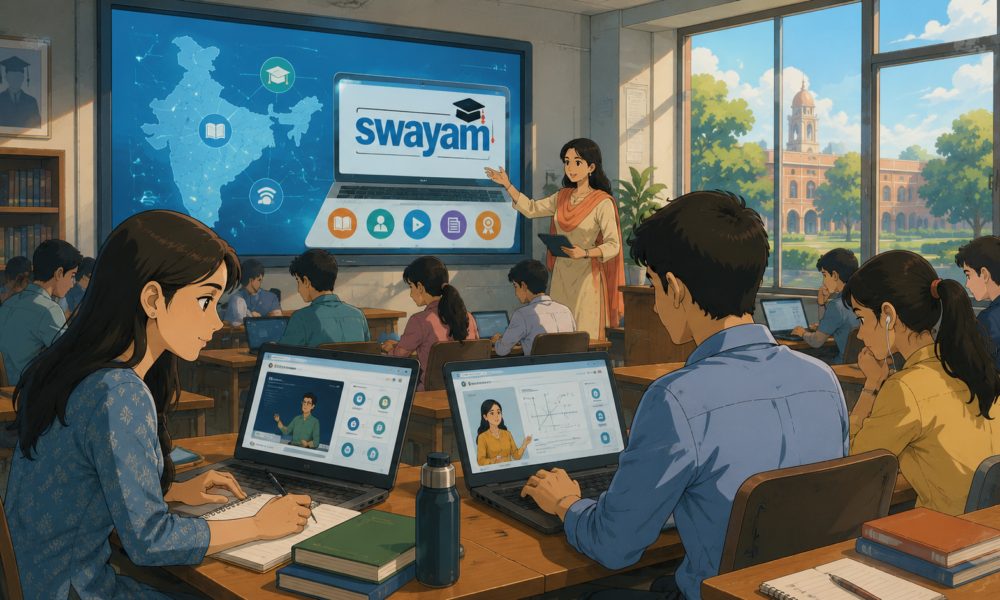
India’s higher education system is taking another step towards flexible and technology-driven learning. The University Grants Commission (UGC) has directed universities and higher education institutions to integrate courses offered through the SWAYAM platform into the July 2026 academic semester, allowing students to earn academic credits through online learning alongside their regular classroom studies. The move is expected to widen access to quality education while supporting the implementation of the National Education Policy (NEP) 2020.
SWAYAM, the Government of India’s Massive Open Online Courses (MOOCs) platform, hosts thousands of courses developed by leading institutions including IITs, IIMs, central universities and other recognised educational bodies. Students can study subjects ranging from engineering and management to humanities, sciences and vocational skills at their own pace while receiving credits recognised by their universities.
The latest UGC directive encourages institutions to embed SWAYAM courses into their academic calendars instead of treating them as optional add-ons. Universities are expected to create awareness among students, facilitate credit transfers and ensure that online learning becomes an integral part of degree programmes rather than a separate initiative.
The decision reflects a broader transformation in higher education. Employers increasingly value continuous learning and multidisciplinary skills, making flexible education models more relevant than ever. Students are no longer limited to the expertise available within a single campus. Through SWAYAM, they can access lectures delivered by some of India’s leading academics while remaining enrolled at their home institution.
For students, the benefits extend beyond convenience. Online courses allow learners to explore emerging disciplines such as artificial intelligence, cybersecurity, sustainability, entrepreneurship and data science without waiting for universities to introduce new departments or faculty. This flexibility can help students personalise their education according to career goals and industry demand.
The initiative is also expected to reduce geographical barriers. Students studying in smaller towns and remote regions will gain access to high-quality educational content that may otherwise be unavailable locally. This supports the government’s objective of improving educational equity through digital platforms while strengthening lifelong learning opportunities.
Universities, meanwhile, may benefit from stronger collaboration across institutions. Rather than duplicating specialised courses, colleges can leverage nationally recognised online content while focusing their own resources on mentoring, practical training and research. Education experts believe this blended approach could improve both teaching quality and academic efficiency.
However, successful implementation will depend on more than policy announcements. Reliable internet access, digital infrastructure, faculty support and student awareness remain essential. Institutions will also need clear mechanisms for academic counselling, credit mapping and assessment to ensure that online learning complements traditional classroom education.
The directive aligns closely with the National Education Policy’s emphasis on multidisciplinary learning, academic flexibility and digital education. It also complements the government’s continued investment in digital higher education, including virtual laboratories, online libraries and technology-enabled teaching platforms.
As India’s education landscape evolves, the distinction between classroom and online learning is becoming less pronounced. Instead of replacing conventional teaching, platforms such as SWAYAM are creating hybrid learning environments where students can combine institutional education with nationally recognised digital courses.
The UGC’s latest move signals that flexible learning is no longer an experimental concept but an increasingly important part of mainstream higher education. If widely adopted, it could help universities deliver more personalised, accessible and future-ready education while preparing graduates for a rapidly changing knowledge economy.





No Comment! Be the first one.