






OpenAI’s Navier-Stokes Breakthrough: Why This Mathematics Problem Matters to Students
OpenAI has announced a major development in mathematics, saying that one of its artificial intelligence systems has produced a solution to the Navier-Stokes existence and smoothness problem, one of...
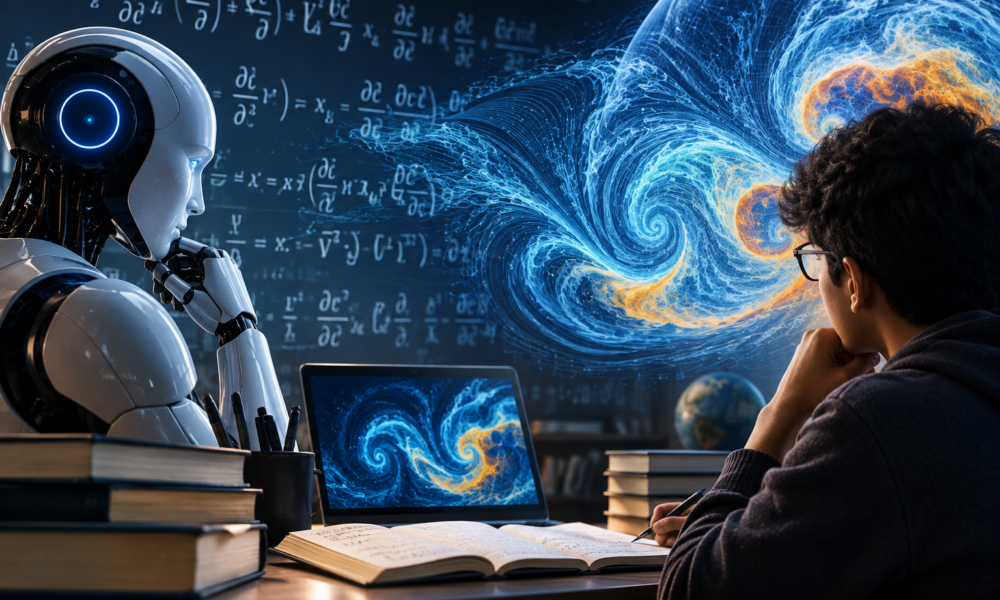
OpenAI has announced a major development in mathematics, saying that one of its artificial intelligence systems has produced a solution to the Navier-Stokes existence and smoothness problem, one of the seven Millennium Prize Problems.
The problem has remained unresolved for nearly 90 years and is linked to the mathematics of how fluids such as water and air move. OpenAI says its internal AI system produced an analytical proof and a formal proof in Lean, a computer language used to check mathematical statements.
The development is important not only for researchers but also for students because it shows how AI could increasingly become part of advanced mathematics, science and engineering.
What Is the Navier-Stokes Problem?
The Navier-Stokes equations are used to describe the movement of fluids. They are important in areas such as physics and engineering and can help researchers understand phenomena ranging from water movement to air flow and turbulence.
The main Millennium Prize question asks whether smooth solutions to the three-dimensional Navier-Stokes equations always exist and remain smooth, or whether they can develop a singularity. The Clay Mathematics Institute lists the problem among its seven Millennium Prize Problems, with US$1 million offered for each solution that meets its rules.
In simple terms, mathematicians want to know whether fluid equations can reach a point where their behaviour becomes mathematically impossible to control.
What Has OpenAI Announced?
OpenAI says its new internal model worked with around 10,000 coordinating AI agents and reached its reported result in about 88 hours. The company says the system produced an analytical proof showing that Navier-Stokes dynamics can develop a singularity in finite time.
The company has also shared a formalisation of the proof in Lean. This is important because formal proof systems can help check whether individual steps in a mathematical argument follow correctly from earlier steps.
However, the announcement should still be described as an OpenAI-claimed solution, rather than a formally accepted solution to the Millennium Prize Problem. The Clay Mathematics Institute’s rules require a proposed solution to be published in a qualifying outlet, remain in the public domain for at least two years and receive general acceptance from the global mathematics community before the prize can be considered.
Why Does This Matter to Students?
The development could change the way students learn mathematics and science.
For students, the story shows that difficult mathematical problems are no longer being explored only with textbooks, calculators and traditional computer programmes. AI systems can now assist researchers with complex mathematical reasoning and help explore problems that have challenged experts for decades.
It could also encourage students to study mathematics, computer science, physics and engineering together. Understanding AI increasingly requires strong mathematical skills, while future scientists may use AI as a research partner rather than simply as a search or writing tool.
The Navier-Stokes equations are also connected to real-world areas such as fluid mechanics, aircraft design, weather modelling and engineering. A deeper understanding of these equations could therefore have wider scientific importance.
The Questions Around the Breakthrough
The announcement has also led to debate. NYU mathematician Tristan Buckmaster and Anthropic researcher Levent Alpöge have raised questions about the relationship between their recent work and OpenAI’s result. OpenAI has denied accessing specific user data, while acknowledging that it cannot completely rule out the possibility that de-identified data from product use may have helped improve its models.
For now, the mathematical community will need to examine the proof carefully.
If the result is independently verified and accepted, it could become a landmark moment in both mathematics and artificial intelligence. For students, it offers a glimpse of a future in which learning mathematics may involve not only solving problems themselves but also learning how to work with AI systems to explore questions at the edge of human knowledge.




No Comment! Be the first one.