







South Korea vs Uruguay: How International Sports Events Create Learning Opportunities for Young Fans
International sports matches can function as informal classrooms, exposing young audiences to geography, culture, languages, sports science and international relations. The recent South Korea versus...

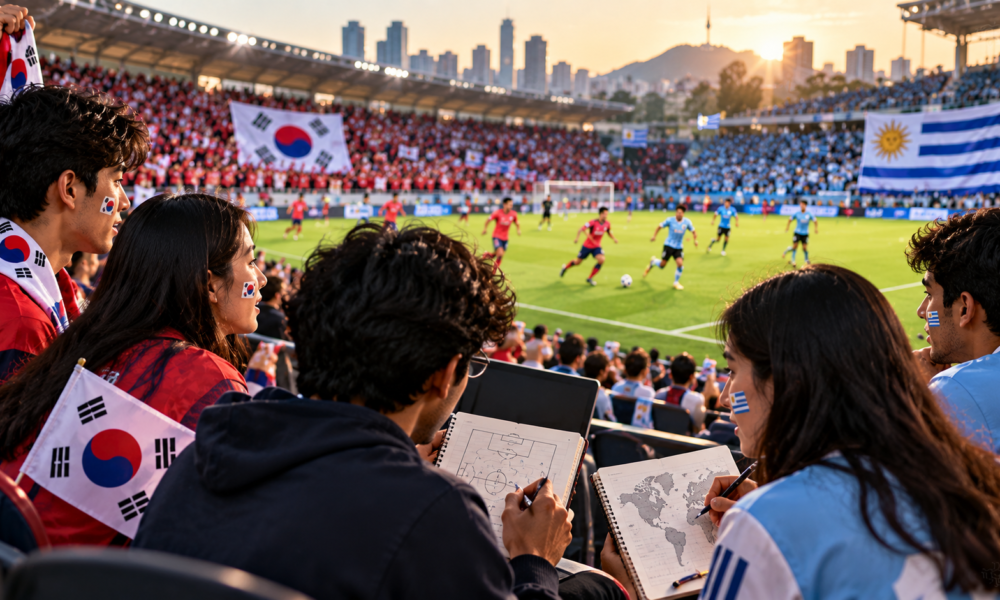
International sports matches can function as informal classrooms, exposing young audiences to geography, culture, languages, sports science and international relations.
The recent South Korea versus Uruguay football friendly provides a timely example. South Korea hosted Uruguay at Seoul World Cup Stadium on September 28, 2026, with Uruguay winning 4-1. Darwin Núñez scored twice, while Giorgian de Arrascaeta also scored and South Korea’s Son Heung-min scored the home team’s only goal.
For students, an international football match can become an opportunity to explore far more than the final score.
Geography is an obvious starting point. South Korea and Uruguay are located on opposite sides of the world, representing very different geographic, cultural and economic environments.
Students can use major sporting events to explore maps, population patterns, languages, transportation systems and tourism.
The match can also become a lesson in sports economics. International fixtures involve stadium operations, broadcasting rights, sponsorships, merchandise, tourism and hospitality.
Students interested in business and management can examine how football clubs and national teams build global audiences.
Sports communication is another learning opportunity.
Football increasingly operates across television, streaming platforms and social media. Students can analyse how match highlights, player interviews, statistics and short-form videos reach audiences across different countries.
Language learning can also benefit from international sports.
A South Korean football match introduces students to Korean names, terminology and cultural references, while Uruguay provides an opportunity to explore Spanish-language sports media and South American football culture.
The match also offers a useful lesson in statistics. Students can study possession, passing accuracy, shots, expected goals, defensive actions and other performance indicators to understand how data is used in modern sport.
Sports science provides another educational dimension. Players operate under intense physical demands and rely on nutrition, recovery, strength training, injury prevention and performance analysis.
The South Korea-Uruguay fixture also had a significant audience in Seoul. Reports said the match was played at Seoul World Cup Stadium, while Son Heung-min’s goal brought him level with Cha Bum-kun’s record of 58 goals for South Korea’s men’s national team.
For teachers, international sporting events can therefore become useful project material.
A class could ask students to research the two countries, compare their sporting systems, analyse match statistics or create a presentation on the economics of international football.
Students can also explore career opportunities associated with sports, including journalism, broadcasting, data analysis, event management, marketing and sports science.
The key point is that sports education does not require students to be professional athletes.
Major international events can encourage curiosity across several academic disciplines while helping students understand how global audiences connect through sport.
The South Korea-Uruguay match therefore provides a timely example of how an international sporting event can become a learning opportunity beyond the football pitch.



No Comment! Be the first one.