








Punjab Surpasses Kerala on Key School Education Indicators, NITI Aayog Report Shows
Punjab has emerged as one of India’s strongest-performing states in school education, with the latest NITI Aayog report showing it ahead of Kerala on several key learning indicators. The findings...

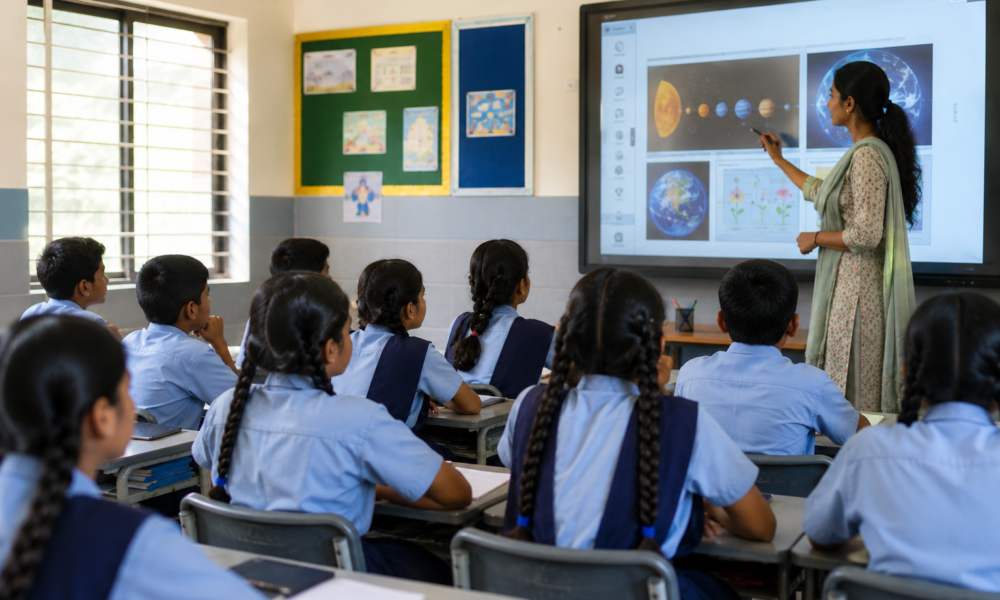
Punjab has emerged as one of India’s strongest-performing states in school education, with the latest NITI Aayog report showing it ahead of Kerala on several key learning indicators.
The findings come from NITI Aayog’s 2026 report, “School Education System in India: Temporal Analysis and Policy Roadmap for Quality Enhancement”. The report examines school education through areas including access, enrolment, infrastructure, learning outcomes, teacher availability, funding and inclusion.
According to figures cited by Punjab Education Minister Harjot Singh Bains, the state recorded 82% proficiency in language and 78% in mathematics among Class 3 students. Kerala recorded 75% in language and 70% in mathematics. Punjab also recorded 52% proficiency in Class 9 mathematics, compared with 45% in Kerala.
The figures are significant because learning outcomes offer a more useful measure of school performance than infrastructure alone. A school may have classrooms, computers and other facilities, but the real test is whether students are gaining the skills expected at their grade level.
Punjab’s reported improvement has been linked to a series of reforms in government schools. One of the programmes highlighted is Mission Samarth, which focuses on improving students’ reading, writing and mathematical abilities by grouping learners according to their learning levels. The programme currently covers nearly 12 lakh students and involves more than 70,000 teachers each year, according to the state’s education department.
Infrastructure has also been a major part of the state’s education push. Punjab has expanded access to electricity, computers and smart classrooms in government schools. NITI Aayog’s report notes that smart classroom coverage varies sharply across India. Punjab had functional smart classrooms in 80.1% of schools in 2024-25, placing it among the states and Union Territories with the highest coverage.
The state has also focused on preparing students for competitive examinations. Its Punjab Academic Coaching for Excellence, or PACE, initiative aims to support government school students preparing for major entrance examinations. The number of NEET qualifiers from Punjab government schools increased substantially, with the state reporting 882 qualifiers in 2026 compared with 80 in 2021.
Teacher development has been another important part of the reform effort. Punjab has invested in professional training and recruitment while attempting to improve classroom teaching and student support. The state has also introduced English-focused learning initiatives and expanded its Schools of Eminence programme.
However, Punjab’s performance should be viewed in the wider national context. NITI Aayog’s report identifies continuing challenges across India, including infrastructure gaps, uneven teacher deployment, differences in learning outcomes, fragmented school structures and growing dependence on private education. It also points to concerns around student wellbeing, vocational education and early childhood education.
The report shows that school improvement is not simply about spending more money. Teacher availability, classroom practice, student assessment, leadership and regular monitoring all influence whether investment produces better learning.
For parents and students, the Punjab example offers an important takeaway. Government schools can improve their academic performance when reforms are sustained and linked to classroom-level needs.
For other states, Punjab’s progress provides a case worth studying, but copying individual programmes may not be enough. Education systems differ widely across regions, and successful reforms need to fit local conditions.
The bigger challenge now is maintaining the gains. Better learning outcomes must continue across different grades and districts, while infrastructure improvements need to be matched by strong teaching.
Punjab’s latest performance therefore represents more than a state-level ranking. It highlights a wider question for Indian education: can consistent improvements in teaching, infrastructure and student support translate into stronger learning outcomes across the country?







No Comment! Be the first one.