








AI Becomes Part of School Education as NCERT and CBSE Roll Out New Curriculum
Artificial Intelligence (AI) is set to become a regular part of school education in India, with the National Council of Educational Research and Training (NCERT) and the Central Board of Secondary...

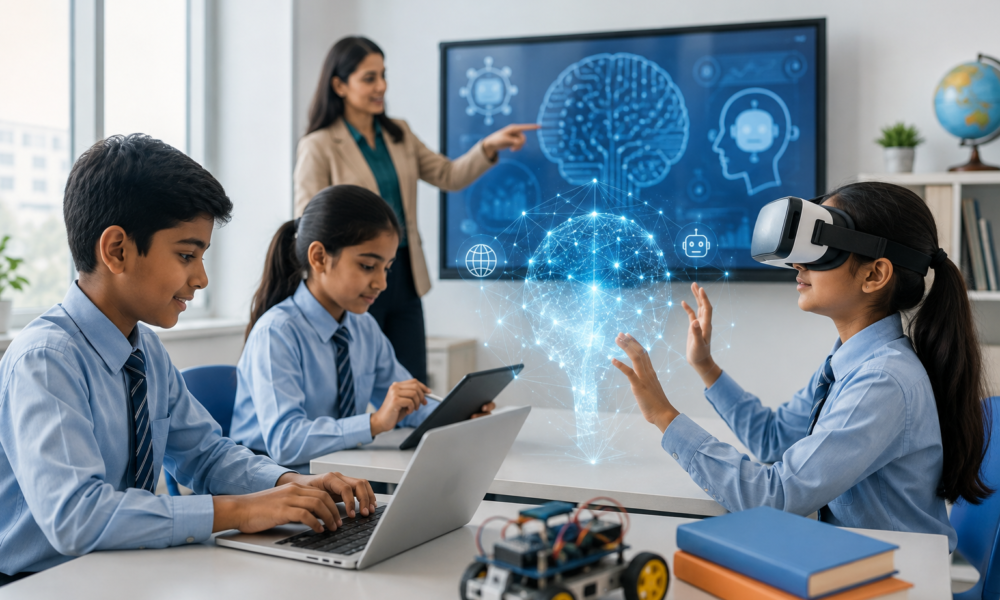
Artificial Intelligence (AI) is set to become a regular part of school education in India, with the National Council of Educational Research and Training (NCERT) and the Central Board of Secondary Education (CBSE) introducing a dedicated Computational Thinking and Artificial Intelligence curriculum for students from Classes III to VIII from the 2026-27 academic session. The curriculum for Classes IX to XII has also been finalised, marking a major step towards preparing students for a technology-driven future.
The new curriculum has been designed to help students develop logical thinking, problem-solving skills, pattern recognition and data literacy from an early age. Rather than teaching students only how to use AI tools, the programme also focuses on understanding how AI works, its limitations and the responsible use of technology. According to the Ministry of Education, computational thinking will act as the foundation for age-appropriate AI learning across different school grades.
To support teachers, NCERT and CBSE have also prepared teacher handbooks and facilitator guides. These resources aim to help schools introduce AI concepts effectively in classrooms. Schools offering AI as a subject will also need to meet infrastructure and affiliation requirements laid down by CBSE, ensuring students have access to the necessary digital resources.
Alongside the curriculum, the government highlighted the Skilling for AI Readiness (SOAR) initiative launched by the Ministry of Skill Development and Entrepreneurship. The programme includes three 15-hour learning modules for students in Classes VI to XII. These modules introduce AI basics, generative AI, programming, ethics, cybersecurity and future career opportunities. A separate 45-hour “AI for Educators” course has also been developed to improve AI literacy among teachers.
The initiative supports the goals of the National Education Policy (NEP) 2020, which encourages schools to introduce modern subjects that prepare students for future careers. It also aligns with the National Curriculum Framework for School Education (NCF-SE) 2023, which recognises the growing importance of artificial intelligence, machine learning, data science and computational thinking in education.
Education experts believe the move reflects changing industry needs. AI is already being used in sectors such as healthcare, banking, manufacturing, retail and logistics. As technology continues to reshape workplaces, students will increasingly need digital skills alongside traditional subjects. The new curriculum is expected to help learners understand emerging technologies without replacing core academic learning.
The government has clarified that while it has developed the curriculum, setting up AI and robotics laboratories remains the responsibility of state governments and Union Territories. This means the pace of implementation may differ across schools depending on available infrastructure and funding.
The introduction of AI into classrooms represents a broader shift in Indian education. Instead of treating artificial intelligence as an advanced optional subject, it is becoming part of everyday learning. Experts say the success of the programme will depend not only on new textbooks but also on teacher training, digital infrastructure and responsible use of technology. If implemented effectively, the curriculum could help prepare millions of students for careers in an increasingly AI-powered economy while encouraging critical thinking and ethical decision-making from an early age.






No Comment! Be the first one.