








AI Education Enters Indian Schools as Classes III to VIII Get New Curriculum
Artificial Intelligence is moving into Indian classrooms at an earlier stage, with the government introducing a dedicated Computational Thinking and Artificial Intelligence curriculum for students...
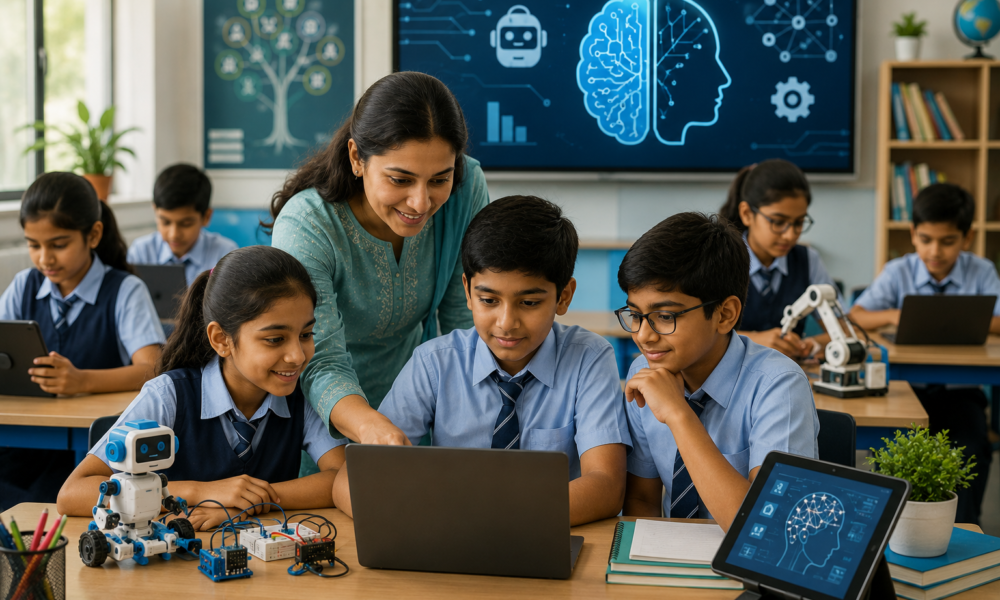
Artificial Intelligence is moving into Indian classrooms at an earlier stage, with the government introducing a dedicated Computational Thinking and Artificial Intelligence curriculum for students from Classes III to VIII from the 2026-27 academic year.
The Ministry of Education said the new curriculum has been developed by the National Council of Educational Research and Training (NCERT) in collaboration with the Central Board of Secondary Education (CBSE). The government has also finalised the curriculum for Artificial Intelligence and related subjects for students in Classes IX to XII.
The move is part of the wider National Education Policy (NEP) 2020, which calls for students to learn about newer areas such as Artificial Intelligence, Design Thinking, environmental education and other emerging subjects.
For younger students, the focus will not simply be on teaching them how to use AI tools. The new curriculum aims to develop basic skills such as logical reasoning, recognising patterns, designing simple algorithms and understanding data. These skills can later help students understand more advanced areas of technology.
The government is also placing importance on the responsible use of AI. Students will be introduced to issues around ethics and the safe use of technology as they learn about artificial intelligence.
This change could have a major impact on how children prepare for future careers. AI is already being used across areas such as technology, banking, healthcare, manufacturing, education, media and transport. As its use increases, basic knowledge of AI and data is likely to become useful even for students who do not eventually become computer scientists or engineers.
The government has also introduced a separate programme called SOAR, or Skilling for AI Readiness. The programme is designed for students in Classes VI to XII and aims to build basic AI knowledge among students and teachers.
SOAR has three 15-hour modules for students. They cover AI awareness, acquiring AI-related skills and preparing students to explore future opportunities. There is also a separate 45-hour programme for teachers called AI for Educators.
The teacher programme is important because simply adding AI to the syllabus will not be enough. Teachers will need to understand the technology themselves before they can explain it properly to students and help them use it safely.
Schools will also need suitable digital infrastructure. The Ministry has said that CBSE’s curriculum specifies the infrastructure required for teaching AI, while schools affiliated with the board are expected to maintain digital facilities under its affiliation rules.
However, implementation could be different from one state to another. Education is a subject on the Concurrent List, and many schools are controlled by state and Union Territory governments. The responsibility for setting up AI and robotics laboratories in these schools therefore rests with the respective state or Union Territory authorities.
The change also reflects the growing importance of mathematics and computational thinking. The government has linked these skills with areas such as AI, machine learning, data science and even climate modelling and infrastructure development.
For parents and students, the biggest change is that AI education is no longer being treated only as a specialised subject for older students. Children will start developing the basic thinking skills behind AI much earlier.
For India, the long-term goal is to create students who can understand, question and use new technology rather than simply consume it. If schools can provide trained teachers, reliable digital infrastructure and practical learning, the new curriculum could give students a stronger foundation for an economy increasingly shaped by AI and digital technology.





No Comment! Be the first one.