








Government Schools Now Account for Less Than Half of Student Enrolment in India
Government schools now account for 49.24% of student enrolment in India, down from 71% in 2005, according to a NITI Aayog report that examines the country’s school education system over the...

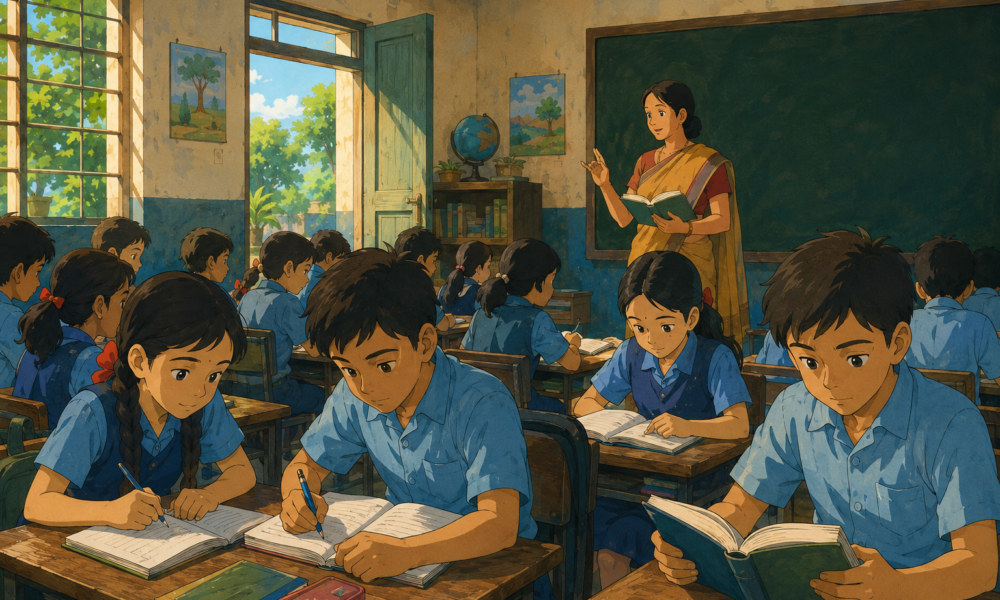
Government schools now account for 49.24% of student enrolment in India, down from 71% in 2005, according to a NITI Aayog report that examines the country’s school education system over the past decade.
The report, titled “School Education System in India: Temporal Analysis and Policy Roadmap for Quality Enhancement”, examines access, enrolment, infrastructure, equity, inclusion and learning outcomes. It draws on data from UDISE+ 2024-25, PARAKH Rashtriya Sarvekshan 2024, NAS 2017 and 2021, and ASER 2024.
The decline in the share of students studying in government schools is one of the key developments highlighted in the report. While government schools continue to educate a large number of children, their share of overall enrolment has fallen considerably over the years.
The change comes alongside a wider shift in India’s school education system. The report notes that the country has made progress in expanding access to primary education, but challenges remain in keeping students in school as they move towards higher classes.
The biggest concern is at the secondary level. The report puts the dropout rate at 11.5% for the secondary stage, compared with 3.5% at the upper-primary level and just 0.3% at the primary level during the period examined. This means that retaining students becomes a much bigger challenge after they move beyond the earlier years of schooling.
The findings are important because leaving school during the secondary years can affect a student’s ability to continue into higher secondary education, vocational training or college. It can also reduce access to better employment opportunities later.
The report does not focus only on enrolment and dropout rates. It also looks at infrastructure and learning outcomes, showing that improving education requires more than simply increasing the number of children entering school.
NITI Aayog has proposed 13 broad recommendations, including eight systemic recommendations and five academic recommendations. These cover areas such as school infrastructure, the development of composite schools, evidence-based school rationalisation, pedagogy, assessment, foundational learning and student wellbeing.
The policy roadmap includes 33 implementation pathways covering short, medium and long-term actions. More than 125 measurable performance indicators have also been proposed to track progress. The report places responsibility across central, state and local authorities rather than treating school education as the responsibility of one department alone.
For parents and students, the figures point to an important question about the quality and appeal of public education. Government schools remain a major part of India’s education system, particularly for families that depend on affordable or free schooling. Strengthening infrastructure, teaching quality and learning outcomes could therefore have a direct effect on millions of students.
The report also shows that improving access is only one part of the education challenge. Keeping students in school, ensuring that they learn effectively and giving them the facilities needed to continue their education will be equally important.
As India works towards its long-term education goals under the National Education Policy 2020, the next challenge will be turning these recommendations into measurable improvements inside classrooms. The success of the roadmap will ultimately depend on whether students stay in school, learn well and have a clear path towards higher education or employment.





No Comment! Be the first one.