







AI Education Moves Into Indian Schools as Artificial Intelligence Becomes a Foundational Skill
Artificial intelligence is increasingly becoming part of India’s school education agenda, with the government working towards introducing AI and computational thinking as components of...

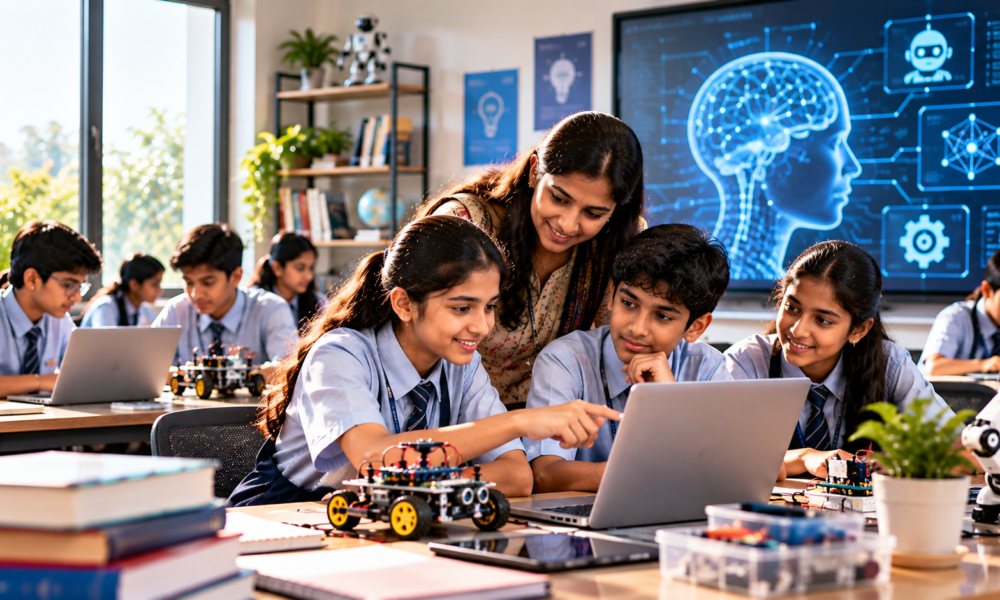
Artificial intelligence is increasingly becoming part of India’s school education agenda, with the government working towards introducing AI and computational thinking as components of future-ready education.
The Ministry of Education has said that AI and Computational Thinking will be developed as important elements of school education, with curriculum work involving institutions including CBSE, NCERT, Kendriya Vidyalayas and Navodaya Vidyalayas.
The approach is broader than teaching students how to use individual AI tools.
The objective is to introduce concepts that help students understand how artificial intelligence works, how computational systems solve problems and how technology can be used responsibly.
The government has described AI education as a basic skill connected to the wider world around students.
This represents a significant change in the way technology is viewed in school education.
Earlier, digital education often focused on computer literacy and the use of software. AI education introduces a different layer, where students may need to understand algorithms, data, computational thinking and responsible technology use.
The proposed approach also connects with the National Curriculum Framework for School Education 2023.
For schools, the shift could require teacher training, new learning resources and curriculum adaptation.
Teachers will need to understand not only the technical concepts but also how AI can be integrated into subjects such as science, mathematics, languages and social sciences.
The issue is particularly relevant because AI tools are already becoming part of students’ everyday lives.
Generative AI can write text, answer questions, create images and assist with research. This creates new opportunities for learning but also raises questions around originality, assessment and academic integrity.
Schools therefore face a balancing act.
Students need to understand AI without becoming overly dependent on it.
That means education about AI needs to include critical thinking and verification alongside technical skills.
The broader economic context also matters.
AI is expected to influence employment across sectors, meaning students entering higher education and the workforce will increasingly encounter workplaces where AI tools are part of everyday operations.
Introducing AI concepts earlier in education could therefore help students develop familiarity with the technology before they reach university.
However, implementation will matter as much as curriculum design.
Schools across India have very different levels of technology access and teacher capacity. Ensuring that AI education does not become limited to well-resourced institutions will be an important part of the implementation challenge.





No Comment! Be the first one.