







South Korea’s Education System: What India Can Learn From It
South Korea’s education system is often discussed internationally because of its strong academic performance and high levels of educational attainment. For India, the country offers useful...

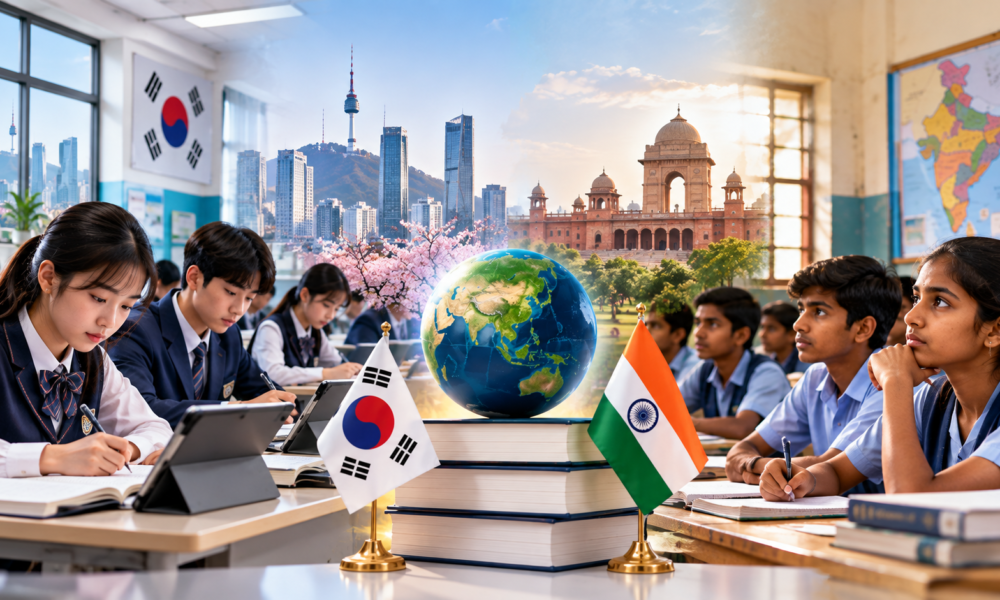
South Korea’s education system is often discussed internationally because of its strong academic performance and high levels of educational attainment. For India, the country offers useful lessons, but also raises questions about academic pressure, inequality and how much competition students should face.
Recent OECD data show that Korean students perform above the OECD average in mathematics, reading and science. In PISA 2025, Korea recorded an average mathematics score of 522 compared with an OECD average of 463. Its science score was 526 compared with an OECD average of 482, while reading stood at 501 compared with an OECD average of 461.
Korea also has a very high level of tertiary education attainment. According to the OECD’s Education at a Glance 2025 profile, 71% of 25–34-year-olds in Korea had completed tertiary education, compared with an OECD average of 48%.
One lesson India can consider is the importance of long-term investment in education and skills. Korea’s education system has developed alongside the country’s broader economic transformation, creating a strong connection between education, skills and employment.
Another lesson concerns academic expectations. Korean students operate in a highly competitive educational environment, particularly around progression to selective higher education. That pressure can produce strong academic outcomes, but it also raises questions about student wellbeing and the balance between examinations and broader learning.
India faces a similar challenge in some respects. Competitive examinations play a major role in access to universities and professional courses, and many students spend substantial amounts of time preparing for them.
However, simply copying another country’s system would not necessarily work. India has a much larger and more diverse population, different regional education conditions and significant differences between urban and rural areas.
The OECD data also show that Korea’s educational achievements do not eliminate inequality. The OECD reports that 85% of Korean 25–34-year-olds with at least one tertiary-educated parent had completed tertiary education, compared with 45% among those whose parents had not completed upper secondary education.
This is an important lesson for India. Academic performance at the national level needs to be considered alongside access and social background.
India could therefore look at several elements of the Korean experience without attempting to reproduce the entire system. These include strong foundational learning, emphasis on mathematics and science, high educational expectations, teacher development and stronger links between education and future skills.
At the same time, policymakers need to consider what should not be copied blindly. A system that produces high academic performance can still create pressure on students and unequal advantages for families with greater resources.
The useful question for India is therefore not whether South Korea has a “better” education system. It is what specific practices can be adapted to Indian conditions.
Education reform is rarely about importing another country’s model. It is about identifying what works, understanding why it works and adapting those lessons to local realities.




No Comment! Be the first one.