







Punjab government says ₹2,300 crore spent on school infrastructure
The Punjab government says it has invested ₹2,300 crore in school infrastructure over the past four and a half years, with thousands of classrooms, laboratories, toilets and computer facilities added...

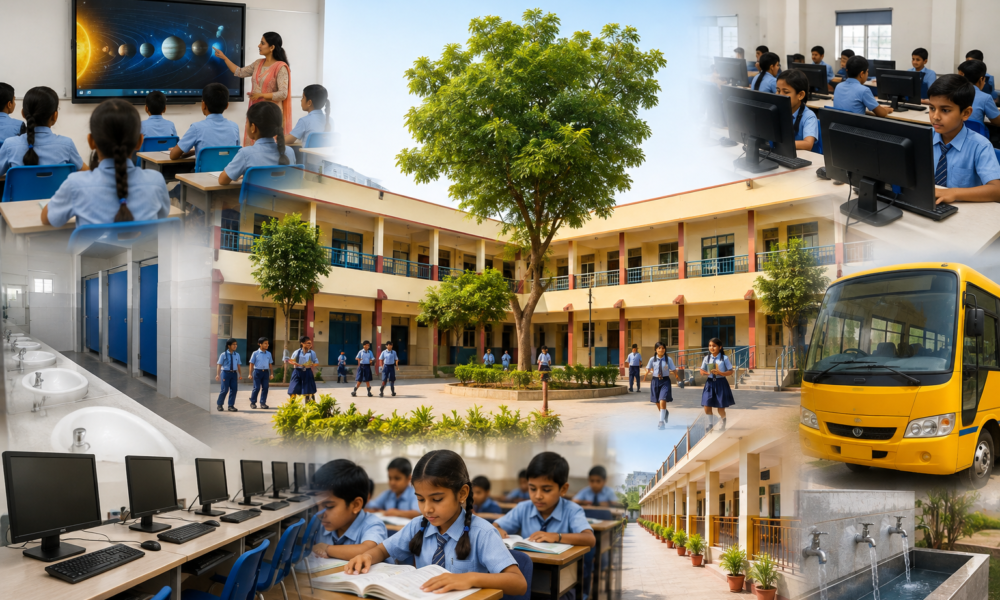
The Punjab government says it has invested ₹2,300 crore in school infrastructure over the past four and a half years, with thousands of classrooms, laboratories, toilets and computer facilities added across government schools.
Punjab Education Minister Harjot Singh Bains presented the state government’s four-and-a-half-year report card on school education on 19 August. He said the investment was part of efforts to improve government schools and strengthen basic facilities for students.
According to Bains, the government inherited several infrastructure gaps in 2022. He said more than 5,000 schools did not have functional toilets, around 4 lakh children were studying without desks and about 500 schools did not have drinking water. He also said many schools did not have boundary walls and textbooks had previously been delayed.
The government says the situation has changed following the infrastructure programme. It has constructed 13,920 new toilets and distributed around 2 lakh desks. According to the education minister, this means students in government schools no longer have to sit on the floor because of a lack of desks.
More than 9,000 new classrooms and laboratories have also been built, while over 10,000 interactive panels have been installed in classrooms. The government says 5,012 schools have received advanced computer laboratories.
Another major focus has been digital access. According to Bains, all government schools in Punjab now have Wi-Fi facilities. He also said 99.9% of government schools have boundary walls.
The changes are not limited to physical infrastructure. Bains also said around 3.64 lakh students have moved from private schools to government schools since 2022. He described the shift as a sign of increasing confidence in government education.
The figures presented by the minister offer a picture of a large-scale effort to improve the physical conditions in government schools. Better classrooms, toilets, desks, computer laboratories and internet access can directly affect students’ everyday school experience.
However, infrastructure is only one part of school education. The quality of teaching, learning outcomes, teacher availability and student performance will also determine whether these investments translate into better education.
The government’s report comes at a time when school infrastructure remains an important issue across India. Basic facilities such as clean toilets, drinking water, furniture and safe classrooms are essential for students to attend school regularly and learn in a suitable environment.
Digital facilities are also becoming increasingly important as schools introduce more technology into teaching. Computer laboratories, interactive panels and internet access can give students greater exposure to digital learning, provided schools have trained teachers and reliable systems to use them effectively.
For Punjab, the reported investment represents a significant push towards upgrading government schools. The state government says the changes have helped make its schools more attractive to families, reflected in the reported movement of students from private to government institutions.
The next challenge will be to maintain the infrastructure and ensure that the improvements continue to support better learning outcomes.
For students and parents, the most important measure will ultimately be whether better buildings and facilities lead to better teaching, stronger academic performance and a better school experience.




No Comment! Be the first one.