








IIT Gandhinagar, CBSE extend Eklavya STEM programme by five years
The Indian Institute of Technology Gandhinagar and the Central Board of Secondary Education have extended their joint Eklavya STEM Programme for another five years, reinforcing a collaboration aimed...

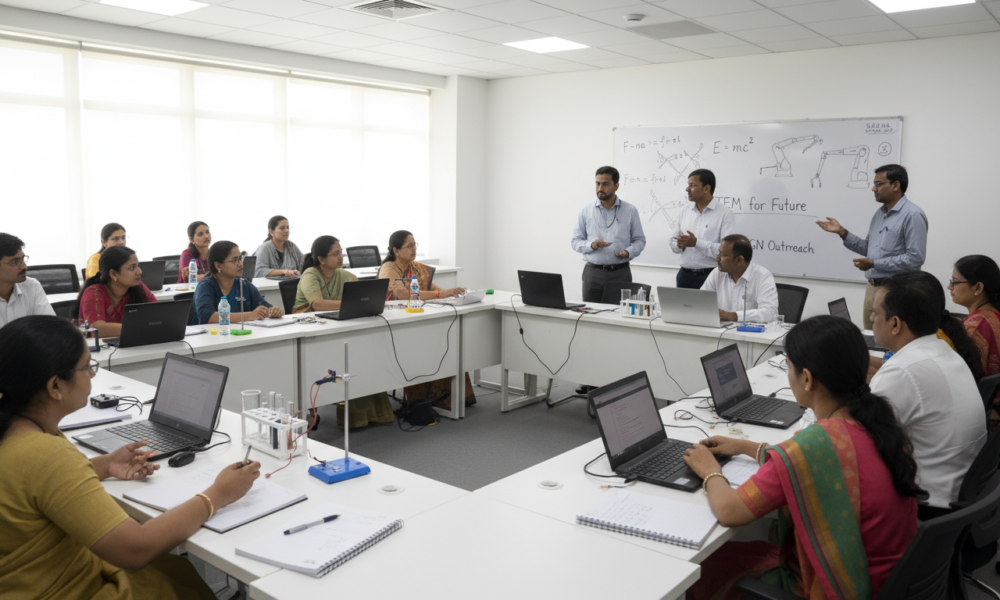
The Indian Institute of Technology Gandhinagar and the Central Board of Secondary Education have extended their joint Eklavya STEM Programme for another five years, reinforcing a collaboration aimed at strengthening science, technology, engineering and mathematics education in schools.
The decision follows the completion of the programme’s first phase, during which it reached teachers and students across multiple regions. The extension will allow the initiative to scale up its outreach, refine its curriculum design and deepen engagement with schools affiliated to CBSE.
Launched as a capacity-building initiative, the Eklavya STEM Programme focuses on training school teachers through structured workshops, hands-on modules and mentoring support. The programme is designed to help teachers move beyond rote learning and adopt inquiry-based, activity-driven classroom practices aligned with contemporary STEM pedagogy.
Officials from IIT Gandhinagar said the next phase will build on feedback from participating educators, with greater emphasis on classroom application, interdisciplinary learning and problem-solving skills. The institute will continue to provide academic leadership, faculty support and resource development for the programme.
The Central Board of Secondary Education noted that the collaboration fits into its broader effort to improve teaching quality and learning outcomes across its affiliated schools. By partnering with a premier technical institution, CBSE aims to expose teachers to updated scientific thinking and practical teaching tools that can be adapted for diverse school contexts.
Over the next five years, the programme is expected to cover more regions, involve a larger pool of teachers and introduce advanced modules in emerging STEM areas, while retaining its core focus on foundational concepts and classroom relevance.
Education experts view the extension as a signal of growing emphasis on long-term institutional partnerships to strengthen school education, particularly in STEM disciplines, through sustained teacher development rather than short-term interventions.







No Comment! Be the first one.