





Budget 2026 Supercharges Education Push: Girls’ Hostels in Every District, 5 University Townships, National Hospitality Institute Planned
The Union Government has unveiled an expansive overhaul of India’s education and skilling architecture in the Education Budget 2026-27, announcing universal girls’ hostels across districts, five...

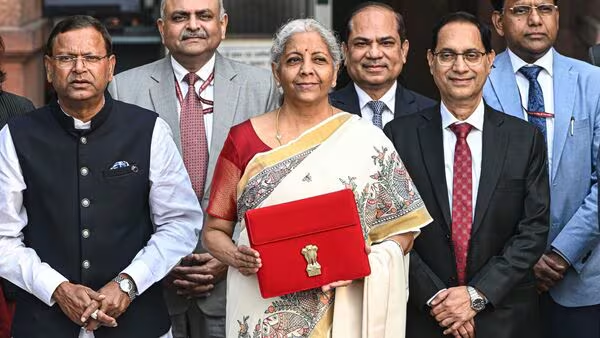
The Union Government has unveiled an expansive overhaul of India’s education and skilling architecture in the Education Budget 2026-27, announcing universal girls’ hostels across districts, five large university townships near industrial hubs, and the establishment of a National Institute of Hospitality, signalling a decisive shift toward access-driven and industry-aligned higher education.
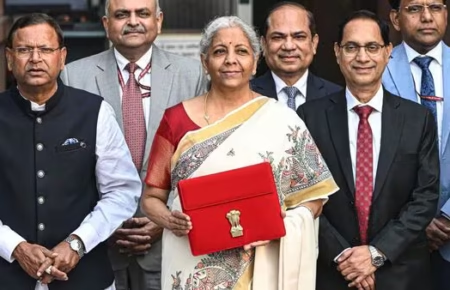
Presenting the Budget, Finance Minister Nirmala Sitharaman said the Centre will roll out girls’ hostels in every district to strengthen female participation in education, especially in aspirational and rural regions, where accommodation remains a key barrier to continuation of studies.
To create integrated education ecosystems, the government will support five university townships near major industrial logistics centres. These townships will house multiple universities and colleges, supported by residential facilities and research clusters, with the objective of enabling closer collaboration between academia, industry, and innovation ecosystems.
In a significant sector-specific move, a National Institute of Hospitality will be established to develop skilled manpower for tourism, travel, and hospitality, sectors viewed as major employment multipliers in the coming decade.
Healthcare education also receives a strong boost. The Budget proposes setting up two new AIIMS and three new Ayurveda institutes, while upgrading National Mental Health Centres in Ranchi and Tezpur into regional apex institutions. The WHO Global Traditional Medicine Centre in Jamnagar, Gujarat, will be upgraded, and medical hubs will be developed in multiple states, including five dedicated hubs focused on medical tourism.
On the skilling side, a pilot programme will train 10,000 tourist guides at 20 iconic sites through 12-week courses, in partnership with the Indian Institutes of Management. The government will also create an Education-to-Employment and Entrepreneurship Standing Committee to steer policy on workforce readiness, job creation, and technology exports, including artificial intelligence.
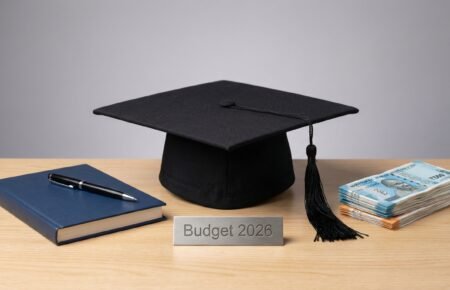
Financial backing for these initiatives is substantial. The total allocation for education in 2026-27 has been pegged at ₹1.28 lakh crore, the highest ever. Of this, ₹78,572 crore is earmarked for School Education and Literacy, while ₹50,077 crore has been allocated to Higher Education.
The government said the package is designed to expand capacity, improve quality, and reposition India’s education system as a direct engine of economic growth and global competitiveness.





No Comment! Be the first one.